Shirdi Sai Baba Temple
Shirdi is famous for Saint Saibaba who is endowed with unprecedented powers, and is worshiped as a God incarnate with a white beard and penetrating glance, clad in the traditional attire of a poor fakir a ragged white robe and a kerchief around the head seated barefoot on a rock, his right ankle resting on his left knee. Both Hindus and Muslims believe in Saibaba and visit the Saibaba Temple at least once in a week, preferably on Thursday. On every Thursday, a special Aarti (prayer) is performed in the temple. Other places of tourist interest are the Gurusthan, the Khandoba Temple, the Shani Mandir, the Narsimha Mandir, the Changdev Maharaj Samadhi and the Sakori Ashram.
History
In history, his parents, birth or birthplace are not known. This mysterious Fakir first manifested himself as a young lad of sixteen under a Neem tree in Shirdi for the sake of Bhaktas and remained there throughout his long life. He transformed the lives of those who met him. For all the seekers he uttered only three words- ‘Allah Achcha Karega’ by way of his blessings. Baba stated that his mission is to “Give Blessings” without discrimination to all, and he proves it in myriad ways by healing the sick, saving lives, protecting the vulnerable, averting accidents, granting offspring, facilitating financial gain, bringing people into harmony within themselves and with each other and, above all, in effecting the spiritual evolution and transformation of those who came to him as the last resort.
Location
Shirdi is a small town in Kopergaon county of Ahmednagar district in Maharashtra state. It falls on Ahmednagar-Manmad State Highway No.10 at 83 Km. from Ahmednagar, and 15 Km. from Kopargaon. It is some 200 miles east of Mumbai (Bombay) and 130 miles north of Pune.
Climate
This pilgrim spot has the most pleasant weather during Monsoons, between June and August. It is the time when the surroundings of Shirdi turn greenery all round. However, it has a mostly dry climate. During summers you can expect the temperature to shoot as high as 40º C in the month of May. Winters can be cold in Shirdi, with January often showing temperature dipping to as low as 7º C.
Pilgrimage Places In Shirdi
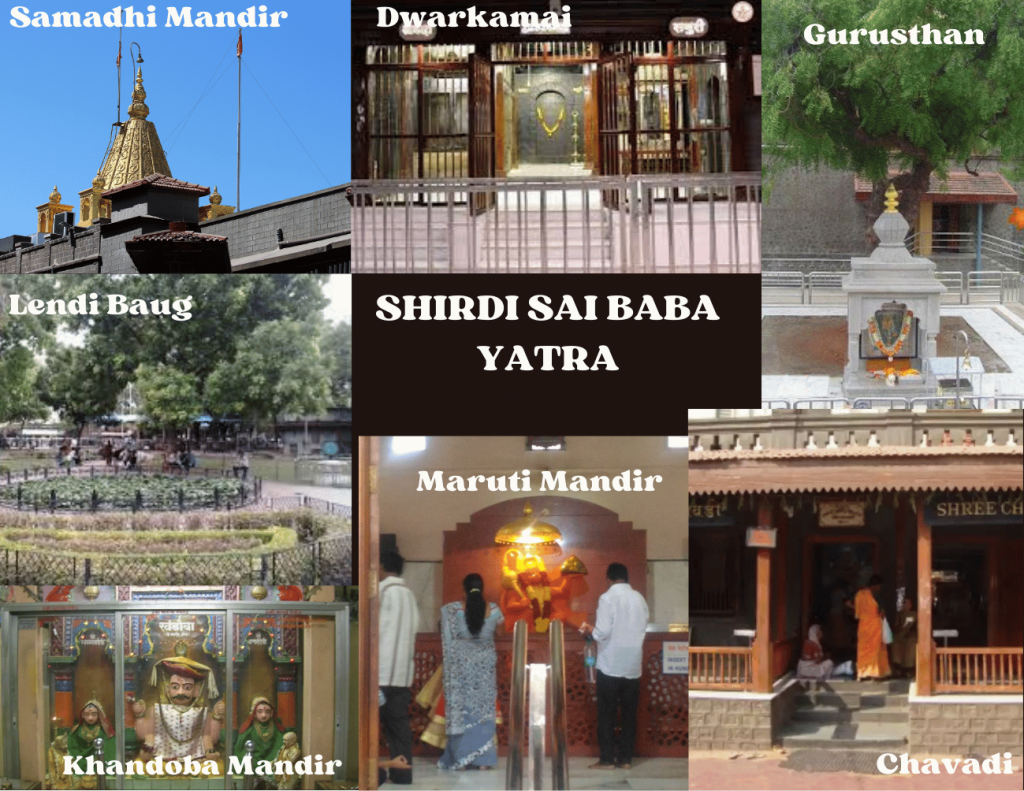
Samadhi Mandir:
This was owned by a millionaire from Nagpur and a famous Sai devotee Shreemant Gopalrao. Baba himself became Murlidhar and the temple became the Samadhi Mandir of Baba. The Mandir is built with stones and Baba’s Samadhi is built with white marble stones. A railing is built in marble around the Samadhi and is full of ornamental decorations. In front of the Samadhi are two silver pillars full of decorative designs. Just behind the Samadhi is Sai Baba’s marvelous statue made of Italian marble which shows him seated on a throne. This idol was made by the late Balaji Vasant. This statue was installed on 7th October 1954. Above the statue is an open, silver umbrella.
Dwarkamai:
This was the place where the sage stayed until the end of his life. Main attraction of the site is the oil paintings of the sage. Baba turned it into Dwarkamai and proved that God is one. The first level of Dwarkamai has a portrait of Baba and a big stone on which Baba used to sit. This level has two rooms. One contains the chariot and the second a palkhi. Just in front of the room where the chariot is kept is a small temple. A saffron flag flies over it. The second level of Dwarkamai has a square stool made of stone, which Baba used for taking a bath.
Gurusthan:
The place from where Sai Baba first came to Shirdi in the form of a Bal Yogi (child ascetic). Sai Baba first came to Shirdi in the form of Bal Yogi – a child ascetic. He was first spotted seated under a Neem tree. This place came to be known as Gurusthan. The renovation of Gurusthan was made on 30th September, 1941. The present temple was built after this period. There is a small shrine in Gurusthan. On a elevated platform of this shrine a big portrait of Baba is placed. On the side is a marble statue of Baba. In front of the portrait is a Shivling and the Nandi. Photos of twelve Jyotirlinga are kept in the temple. At a short distance lies Baba’s CHAVADI. Baba used to sleep here every alternate day.
Chavadi:
The Chavadi is divided into two parts. One part of the Chavadi has a large portrait of Baba along with a wooden bed where Baba used to sleep and a white chair belonging to him.
Maruti Mandir:
It is located at some distance from the cottage of Abdul Baba where he visited with Devidas, a Bal yogi, who lived at the Mandir ten to twelve years before Baba arrived.
Lendi Baug:
At some distance from Gurusthan there is the Lendi Baug. This Baug was made and watered daily by Baba himself. It got its name from a Nalla (a drain) which used to previously flow there. Baba used to come here every morning and afternoon and take rest under a Neem tree. Baba dug a pit, 2 feet deep, under the Neem tree and kept a Deep lit in that pit. One octangular Deepgriha called Nanda Deep has been built in marble stone in memory of this place. It constantly burns in a glass box. On one side of the Deepgriha is a Peepal tree and on the other side is a Neem tree.
Khandoba Mandir:
This temple is situated on the main road. In front of this temple Baba was welcomed by Poojari Mhalsapati, of this temple, saying “Aao Sai”, when Baba stepped in Shirdi. In this temple there are icons of Khandoba, Banai and Mhalsai.
Book Tour to Shirdi Sai baba Yatra Shirdi Sai baba Yatra Shirdi Sai baba Yatra
We have several Tour Packages in your convenient way (including accommodation, food and travel).
Schedule & Tariff: Please call on +91 44 4359 6232 to find out exact and updated schedule & tariff information.
Leave a Reply